
News
Diego Garrido: more than just saves — the goalkeeper as a decisive factor in the game
By Union Vrede FC editorial team3 November 2026
With Denmark he reached fourth place in Europe. In his work with goalkeepers, Diego Garrido looks beyond the next save: game intelligence, decision-making and confidence form the basis of his approach.
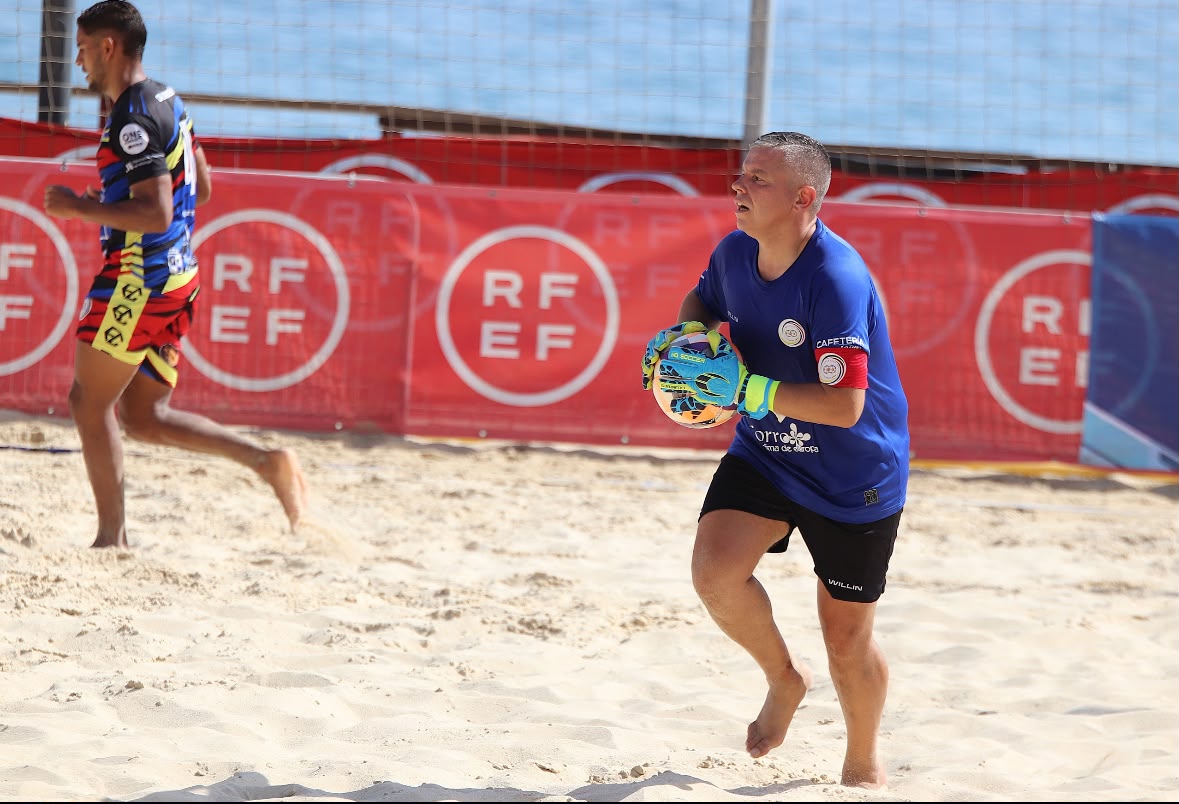
Stopping a shot is visible. The preparation leading up to it is much less so. Choosing the right position, reading an opponent, refocusing after conceding a goal or recognising when to build up the attack yourself: for Diego Garrido, it is all part of goalkeeping.
As a goalkeeper coach in beach soccer, he works in a position that must constantly switch between defending and attacking. His starting point remains clear: better performance starts with a goalkeeper who understands what he is doing and has confidence in his abilities.
With the Danish national team he was part of a historic European campaign. In addition, he is building his own training project for goalkeepers. In this interview, conducted before the World Winners Cup in Alanya, Diego talks about his development as a coach, his collaboration with Casper Dorph and the details that make the difference at the highest level.

1. Can you briefly introduce yourself and tell us something about Diego outside of sports?
I am Diego Garrido, someone who likes to stay busy, is approachable and works with passion in everything he do.
Sport plays a very important part in my life, but I also like to make time for my family, my friends and the little things of everyday life.
Professionally, outside of football, I am active in the insurance sector and in protecting people. Even there I can develop something that I consider essential: listening, helping and building trust.
I consider myself a positive and hard-working person with a lot of energy. I like to keep learning, share experiences and take on new challenges.
I try to enjoy the journey, without ever forgetting the importance of the people who accompany me along the way.
2. How did your connection with football and beach soccer begin, and where does your passion for goalkeeping come from?
My connection with football started at a very young age, like so many children who find a ball a way to have fun and express themselves.
The position of goalkeeper has always seemed special to me. It is different, demanding and requires a very specific personality. A goalkeeper must be able to handle responsibility, make constant decisions and learn to get back up after every mistake.
Over time, beach soccer crossed my path. I discovered a discipline that attracted me because of its intensity, spectacle and high demands.
Today I have the fortune to enjoy both worlds and transfer knowledge from one to the other.
Goalkeeping is not just a position within the team. It is a way to understand the game.
3. How did you start specializing in goalkeeper training and which experiences have shaped your journey the most?
My specialization arose from my passion for goalkeeping and the need to better understand everything that goes into it.
Through the years I realized that simply liking to train goalkeepers was not enough. You had to observe, study, listen and find tools that could truly help them perform better.
I have had the opportunity to work in various environments within football and beach soccer: from daily work with players to experiences at clubs and at international level.
Each phase has taught me something different.
My experience with the Danish national team was particularly important. Working in an international environment forces you to adapt, be precise and make use of every available minute.
My most important lesson is that a good coach never stops being a student.
4. You have a goalkeeper academy. What is it called, how did the idea come about and what opportunities does it offer to goalkeepers who want to learn from you?
My training project for goalkeepers came from a very simple idea: to offer a place where every keeper can work specifically, feel supported and develop their full potential.
I have always felt that the goalkeeper position needs special attention. Performing exercises is not enough. You have to understand the characteristics of each player, their needs and the phase in which they are developing.
My intention is to offer personal, demanding and adapted training, in which we can work on technical, tactical, physical and mental aspects.
I want goalkeepers to find an environment where they are allowed to make mistakes, learn, ask questions and build confidence.
More than training goalkeepers who make big saves, I want to help shape goalkeepers who understand the game and believe in their abilities.

5. What is your working philosophy? What do you want every goalkeeper to take away from your academy besides technical progress?
My philosophy relies on three pillars: work, trust and game understanding.
I like to train with intensity, but I always look for every exercise to have meaning and be truly applicable in competition.
I do not believe in training to simply pile up repetitions. I believe in training to better interpret situations, make decisions and act.
But there is also a human side that I find indispensable.
I want every goalkeeper to learn to manage their emotions, trust themselves, respect their teammates and understand that mistakes are part of the learning process.
If a goalkeeper is technically better after our cooperation, but also more self-assured, more responsible and more aware of their possibilities, then I will feel that we have done good work.
Performance is important, but the human always comes first.
6. You have worked as a goalkeeper coach with the Danish national team. How did that opportunity arise and what has working in an international environment taught you?
Being part of the technical staff of the Danish national team is a very important opportunity in my path.
Ending up in an international environment means taking responsibility and showing that you can add value within a joint project.
From the first moment I tried to understand the needs of the team and put my knowledge at the service of the goalkeepers and the technical staff.
Working with players with different profiles and participating in international competitions forces you to constantly improve yourself.
I also learned a lot from living together, match preparation and the importance of working in the same direction together.
Representing a national team is a privilege, but also a responsibility that I try to live up to every day with my work.
I want to thank Llorenç Gómez for the opportunity he gave me at the time, and Casper, the new coach, who trusts my work.
7. Denmark finished fourth in Europe this year. How did you experience that journey from the staff side and what do you want to emphasize about the work of the goalkeepers?
It was a very special experience.
Fourth place in the Euro Beach Soccer League 2026 means the best European ranking in the history of Denmark. That has enormous value for everyone who is part of this project.
From the inside you experience that with a lot of intensity. Hours of preparation, conversations, analyses, training sessions and small details that are often not visible precede it.
With the goalkeepers, I would especially emphasize their commitment, their willingness to work and their ability to handle extremely demanding situations.
I am proud to have been able to guide them during this process and contribute to their preparation.
But the most important thing is to understand that this result does not belong to one person. It is the result of the efforts of players, technical staff and all people who work on the growth of Danish beach soccer.
We made history, but the best thing is the thought that we still have room to grow further.
8. In beach soccer, the goalkeeper also participates in the build-up and can be decisive in attack. How do you prepare a keeper for those responsibilities?
The beach soccer goalkeeper has a huge influence on the course of a match.
He must not limit himself to defending his goal. He must interpret the game, participate in the attacking build-up, recognize spaces and make quick decisions.
That is why I try to simulate real match situations during our training sessions.
We work on passing accuracy, reading attacking situations, making decisions and the ability to adapt to different scenarios.
I also find it essential that a goalkeeper understands when to take a risk and when to let the game proceed in a simpler way.
A goal from a keeper is always spectacular, but behind that action must be preparation and understanding of the right moment.
My goal is that the keeper not only participates in the game, but can also exert a positive influence on it.

9. How do you help your goalkeepers deal with pressure, recover after conceding a goal, and approach a penalty shootout?
Dealing with emotions is a fundamental part of our work.
A goalkeeper can play a strong match and still concede goals. The most important thing is how he interprets those situations and how he reacts afterwards.
The message I try to give them is that we cannot control everything that happens, but we can control our attitude, our preparation and our reaction.
After a mistake, you must first restore your attention and focus again on the next action.
At penalties we work on technical aspects and observation, but also on confidence, routines and the ability to stay calm.
I want my goalkeepers to feel that they have tools to tackle such moments and do not solely depend on inspiration.
And there is something I find essential: a goalkeeper must feel that his coach believes in him, especially when things are not going well.
10. How would you describe your collaboration with Casper Dorph and what is essential for a good collaboration between head coach and goalkeeper coach?
My professional relationship with Casper Dorph is based on respect, communication and the shared objective to help Denmark perform at the highest level.
I think a goalkeeper coach must perfectly understand the game idea of the national coach.
We cannot work as independent departments. The preparation of the goalkeepers must be connected to what the team needs.
For me it is essential to listen, make proposals and accept that every decision must serve the collective interest.
Every staff member has his responsibility, but we must all go in the same direction.
A good staff is not a staff where everyone thinks exactly the same, but a staff where everyone works together towards the same goal.
11. What should the goalkeepers of Union Vrede prioritize in their preparation for the World Winners Cup in Alanya, especially with little joint training time?
When preparation time is limited, I find it essential to set priorities.
First you have to understand what the team needs from its goalkeepers and which situations can return during the competition.
I would mainly work on defensive communication, decision making, specific goalkeeping actions and participation in the build-up.
I would also pay attention to set pieces and mental preparation for matches that demand the utmost.
But one aspect makes the difference for me: trust.
When a team has little preparation time, players must feel at ease, understand their responsibilities and clearly know what is expected of them.
It is not always about training more, but about utilizing every training minute better.
And of course we must not forget that a competition at this level is also an extraordinary opportunity to learn, compete and enjoy.
12. Is there a goalkeeper, a development or a moment from your coaching career of which you are particularly proud? We would love to hear that story.
There are many moments that I keep with special warmth, but honestly I find it difficult to choose just one.
Important results and major competitions provide unforgettable memories, but there are other situations that have enormous value for me.
Seeing a goalkeeper overcome a difficulty, seeing him find his confidence back after a difficult period or seeing him execute something in a match that we have worked on for weeks: that gives a satisfaction that is difficult to describe.
Of course, the fourth European place with Denmark in 2026 has a special place in my path.
But I am equally proud when a goalkeeper finishes a training session with a smile, understands something he struggled with earlier or discovers that he can do more than he thought.
Trophies are part of our history, but it is the people and their development that really leave a lasting impression.
13. What future goals do you have for your academy and what message do you want to give to our goalkeepers, youngsters who dream of this position and the supporters of Union Vrede?
My goal is to continue growing as a coach and further build a training project that can help more and more goalkeepers.
I want to keep learning, share experiences and create opportunities so players can develop their abilities in an environment of trust and high expectations.
I also look forward to staying connected with international projects and contributing my experience to the growth of beach soccer.
To the goalkeepers of Union Vrede I would say: make the most of every training session and every opportunity to play matches.
To the youngest: do not be afraid to make mistakes, be curious and never lose the enthusiasm to learn.
Goalkeeping is a wonderful position, even though it is sometimes difficult. It requires courage, personality, patience and a lot of perseverance.
And I want to thank all supporters of Union Vrede for their support of their players and the sport.
Enjoy the journey. Work with humility, play with personality and always keep believing in your abilities.
Many thanks to Union Vrede for the opportunity to share a piece of my story and my vision on this sport. 🧤⚽️
The next save counts. But for Diego the work starts much earlier: understanding the game, building trust and preparing for the next decision.
