
News
11 November in Belgium — Armistice Day and the memory of the First World War
By Union Vrede FC editorial team11 November 2026

11 November in Belgium — Armistice Day and the memory of the First World War
On 11 November, Belgium pauses to reflect on the armistice of 1918. It came into effect at eleven o'clock in the morning and brought an end to the fighting on the Western Front. Today, 11 November is a legal public holiday throughout Belgium. In Brussels, Ypres and other Belgian municipalities, the date also holds a place in public life with commemorative ceremonies. The date refers to a single moment in history, but the ceremonies also convey what the war meant for the people who lived through it. Royal Museum of the Armed Forces and Military History · FPS Employment, Labour and Social Dialogue · City of Ypres
Belgium at war
On 4 August 1914, the German army invaded neutral Belgium. The German advance brought fighting around Liège, Namur and Antwerp, among other places. Civilians were also affected. The War Heritage Institute documents plunder and executions during the advance, including in towns and municipalities such as Dinant, Visé, Dendermonde and Leuven. Belgium's wartime history therefore concerns both the front line and the fate of the population. War Heritage Institute
In the autumn of 1914, the Belgian army retreated behind the Yser. By opening the sluice gates at Nieuwpoort, part of the Yser plain was flooded. The inundation helped to halt the German advance there. Further inland, heavy fighting also took place around Ypres. The military cemeteries and memorials in the Westhoek today preserve the traces of those war years. Royal Museum of the Armed Forces and Military History · Commonwealth War Graves Commission

De overstroomde IJzervlakte bij Nieuwpoort, oktober 1914. Fotograaf onbekend. Bron Wikimedia Commons, publiek domein.
What happened on 11 November 1918
The Allies and Germany concluded the armistice in a railway carriage in the Forest of Compiègne in northern France. The agreement was signed on 11 November and came into effect at eleven o'clock that same morning. From that moment on, the guns on the Western Front fell silent. This explains why the time of eleven o'clock still holds a special significance during commemorations. Élysée, historical dossier on Compiègne · Imperial War Museums
The armistice regulated the cessation of hostilities. The peace terms with Germany were later shaped in the Treaty of Versailles, which was signed on 28 June 1919. Both dates therefore refer to a distinct event. On 11 November, we commemorate the moment when the fighting on the Western Front ceased. June 1919 saw the signing of the peace treaty. Élysée, historical notes on 11 November

Maarschalk Ferdinand Foch en de geallieerde delegatie bij het spoorwegrijtuig na de ondertekening van de wapenstilstand. Bos van Compiègne, 11 november 1918. Fotograaf onbekend. Bron Wikimedia Commons, publiek domein.
The Unknown Soldier in Brussels
At the foot of the Congress Column in Brussels lies the Tomb of the Unknown Soldier. An unidentified soldier was buried there on 11 November 1922. The eternal flame burns at the tomb. The unknown soldier symbolises the victims of war. His grave gives that memory a permanent place in the capital. Belgian federal government · Buildings Agency
The national commemoration can also take on a broader meaning. On the centenary of the armistice in 2018, the federal government paid tribute at the tomb to the victims of both world wars and to military personnel who have died since 1945 during peace operations or humanitarian operations. Thus, this ceremony demonstrates how a place of remembrance originating from the aftermath of the First World War also provides space for the memory of later losses. Belgian federal government

Het Graf van de Onbekende Soldaat en de eeuwige vlam aan de voet van de Congreskolom in Brussel. Foto door Martin Kraft, via Wikimedia Commons, CC BY-SA 4.0.

Ypres and the Last Post
The Menin Gate in Ypres was inaugurated in 1927. The monument bears the names of tens of thousands of Commonwealth servicemen who fell in the Ypres area and have no known grave. For those searching for a name, the gate is also a place of personal remembrance. The names connect the grand narrative of the war with the fate of individual people. Commonwealth War Graves Commission · Last Post Association
On 2 July 1928, the Last Post Association organised its first ceremony there. The Last Post was originally a military bugle call signalling the end of the day. During the commemoration, it sounds as a farewell greeting to the fallen. The daily ceremony was interrupted during the German occupation of Ypres in the Second World War. Today, it is held again every evening at 8 pm and is freely accessible. Last Post Association, history · Last Post Association, daily ceremony
On Armistice Day, Ypres also organises a special ceremony around 11 o'clock, the historical time when the armistice took effect. The city commemorates the war at various locations. The 2026 programme included a service of remembrance at the French military cemetery Saint-Charles de Potyze, a ceremony at the Belgian Monument and the Last Post at the Menin Gate. City of Ypres, Armistice programme 2026

De Last Post-plechtigheid aan de Menenpoort in Ieper. Foto door Trougnouf (Benoit Brummer), via Wikimedia Commons, CC BY 4.0.

How the red poppy became a symbol
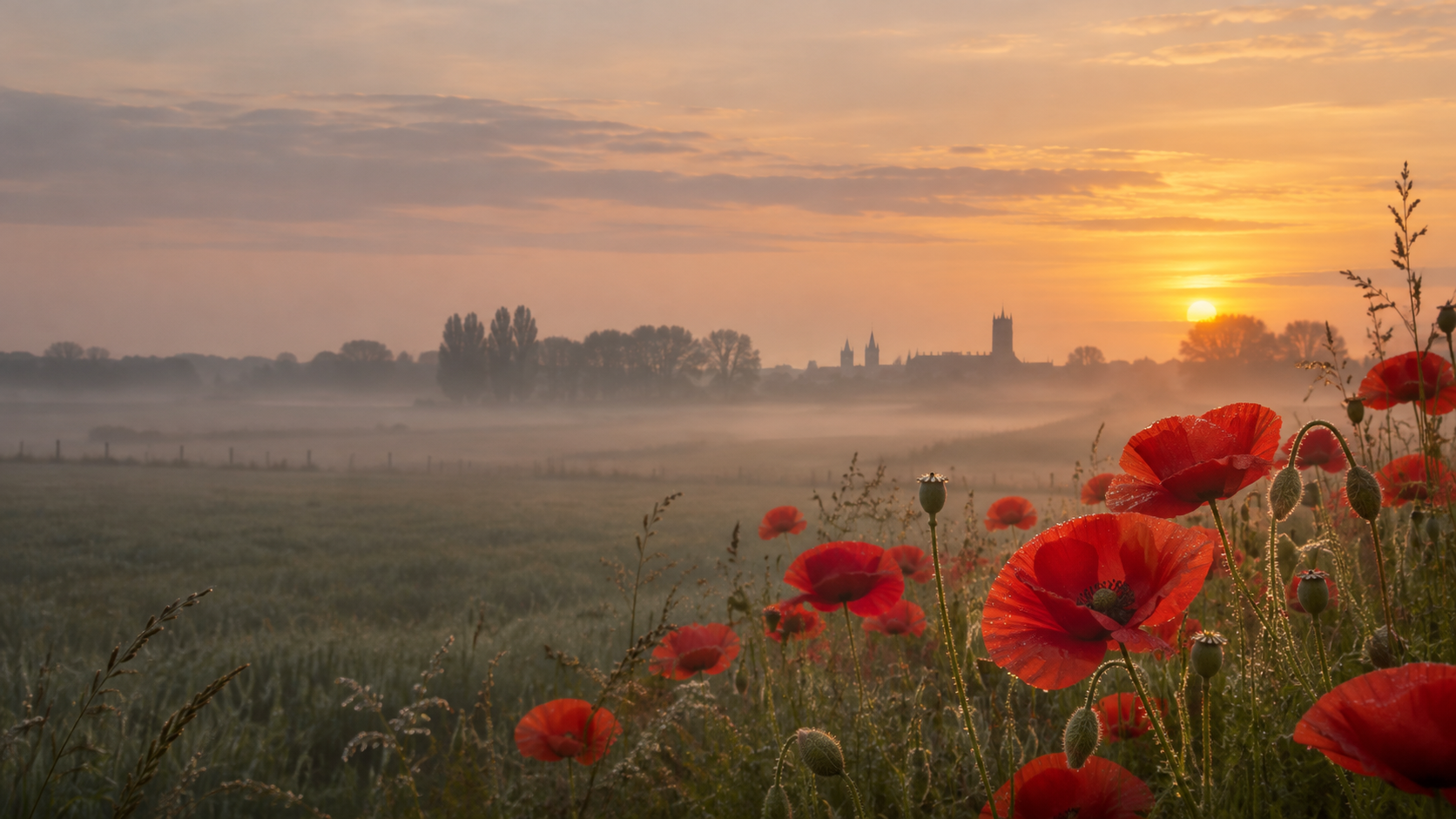
The red poppy is closely associated with In Flanders Fields, the poem written by Canadian military physician John McCrae in May 1915 in the Ypres area. In it, McCrae evokes the image of poppies blooming among the wooden crosses of graves. The poem was published in December 1915 in the British magazine Punch. In Flanders Fields Museum, the poem · In Flanders Fields Museum, publication history
The flower earned its place in commemorative culture partly through people who adopted the image from the poem. The American Moina Michael proposed using the poppy as a symbol of remembrance. In the English-speaking world, the flower became established under the name poppy as a sign of remembrance of the First World War. Its bond with the Westhoek remains recognisable in the poem and in the commemorations in and around Ypres. In Flanders Fields Museum, commemorative flowers · City of Ypres

De eerste publicatie van ‘In Flanders Fields’ van John McCrae in het Britse tijdschrift Punch op 8 december 1915. Scan via de Academy of American Poets, publiek domein.
What Belgium commemorates on 11 November
The Congress Column and the Menin Gate shape the same memory in different ways. In Brussels, the tomb of a single soldier whose name is unknown symbolises many victims. In Ypres, thousands of names are inscribed on a monument to soldiers who have no known grave. At both places, the loss of war is given a human scale. Belgian federal government · Commonwealth War Graves Commission
On 11 November, those memories converge around a precise moment. At eleven o'clock on 11 November 1918, the fighting on the Western Front ended. More than a century later, a bugle call, a wreath and a red poppy bring that history back to the fore. Each in their own way, they express the memory of the people affected by the war. Imperial War Museums · Last Post Association · In Flanders Fields Museum

Rode klaprozen vallen van de Menenpoort in Ieper tijdens de herdenking van Wapenstilstand op 11 november 2013. Foto: Adrian Harlen/MOD, via Wikimedia Commons, Open Government Licence 1.0.
